
There is a version of me preserved somewhere on the internet who called herself a writer in progress. I rather like her. She was enthusiastic, a little chaotic, reading everything she could get her hands on, starting blogs, joining communities, discovering independent authors, thinking about novels and trying to work out what exactly it meant to call yourself a writer. She knew she wanted to write. She definitely had no idea where that decision would eventually take her.
That was 2014.
If you had told that version of me that writing would become such a big part of my life—that I would publish books, study storytelling and language, build a career editing other people’s manuscripts, teach writers, run workshops, critique more books than I could possibly have imagined reading, and eventually spend most of my working life talking about stories—I suspect she would have been thrilled.
And then immediately terrified.
What I don’t think she would have understood yet was that almost none of it would happen alone.
For all our romantic ideas about writing being a solitary pursuit, so much of what has made me the writer I am today happened because other writers were there. My earliest years online were heavily influenced by the book community. I was reading voraciously, reviewing books, talking to authors and gradually discovering the enormous ecosystem around literature.
Then came the writing communities.
By 2015, I had thrown myself rather spectacularly into WriMo culture. I participated in JuNoWriMo while working on the manuscript that would eventually become my first novel, Deceived, finishing that month with a little over 50,000 words. Almost immediately afterwards came Camp NaNoWriMo, where I continued working on the manuscript. Later that year, I participated in NaNoWriMo and crossed 50,000 words again.
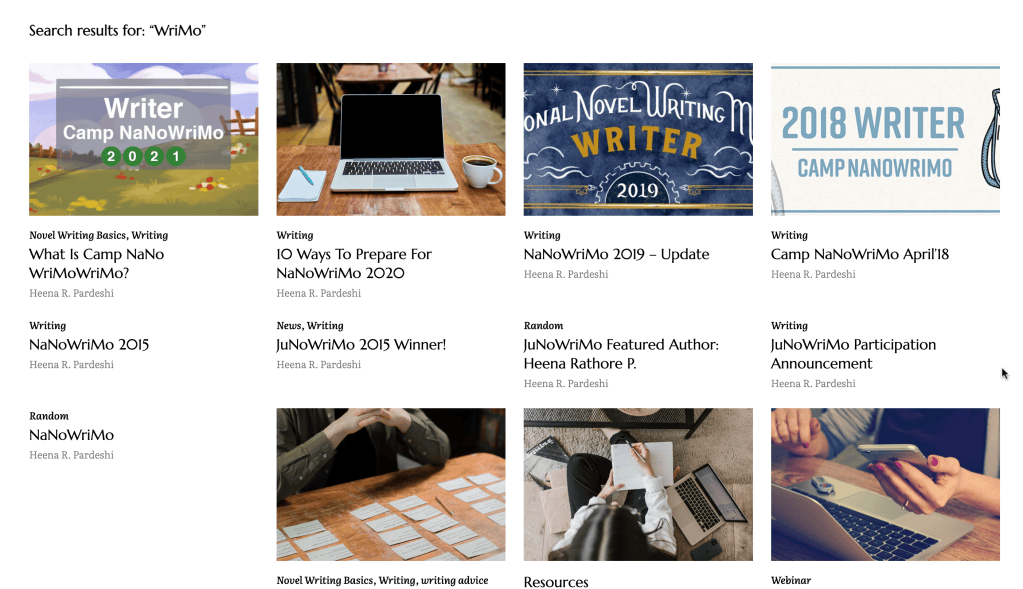
Over the years, there would be more writing challenges, more NaNoWriMos, more drafts, more ambitious word-count targets and considerably more complicated manuscripts.
There is an old update of mine from NaNoWriMo 2019 in which I was working on the seventh draft of Sinister Town and had written 29,132 words by the middle of November.
The seventh draft!
If nothing else convinces you that writers are peculiar creatures, voluntarily rewriting the same imaginary disaster seven times ought to do it.
But when I look back at those years now, I don’t remember only the word counts. I remember the people. I remember checking other writers’ progress, talking about stubborn characters and disappearing plots, and the strange camaraderie of knowing that somewhere, possibly on the other side of the world, another person was staring at a blinking cursor while trying to convince themselves that 1,667 words in a day was perfectly reasonable behaviour.
I remember announcing goals publicly because sometimes accountability was the only thing standing between me and procrastination. I remember celebrating other people’s milestones. I remember people celebrating mine.
And slowly, almost without realising it, I began learning one of the most important lessons of my writing life: you may write a book alone, but you do not have to become a writer alone.
Writing communities also taught me to finish. We talk a great deal about talent in writing, but I think we should talk more about stamina. Ideas are relatively easy to love. Beginnings are intoxicating. A new manuscript contains every possibility because nothing has gone wrong yet.
Then comes page 70. Or page 170.
The beautiful premise develops structural problems. The character you thought you understood refuses to cooperate. The subplot you were certain was brilliant begins behaving like an uninvited relative who has moved into your house.
This is where writing communities matter. Watching other writers struggle taught me something enormously liberating: struggling with a manuscript was not evidence that I lacked ability. It was part of making the thing.
People restarted novels. They missed targets. They wrote dreadful chapters. They discovered plot holes large enough to swallow entire casts. They changed genres. They killed characters they had spent months developing. They deleted ten thousand words and complained about it magnificently.
And then they came back the next day.
That mattered. Writing alongside other people taught me that consistency is far more valuable than waiting for inspiration to arrange itself beautifully around you. You learn to show up at the page. Some days, you write wonderfully. Some days, you write something you will later examine with genuine concern. You keep going.
That lesson has followed me through every part of my career.
When NaNoWriMo eventually shut down, I felt the loss more deeply than I expected.
By then, NaNo had been woven into my writing life for years. It had given me deadlines, ridiculous word-count targets, companionship, accountability and, perhaps most importantly, a recurring reminder that there were thousands of other people somewhere in the world trying to make stories exist at the same time.
So when that chapter ended, I found myself missing the structure of writing alongside other writers.
More recently, I returned to that experience through the Himalayan Writing Retreat’s First Draft Club, or FDC, a writing community that, rather fittingly, originally grew out of NaNoWriMo itself. The First Draft Club began in 2020 as a space where writers could work towards their own writing goals together, and it has since developed into a recurring community built around writing sprints, accountability, conversations with writers and publishing professionals, and the very simple act of showing up to write alongside other people.
Rejoining a structured writing community after so many years has felt strangely familiar.
The technology is different. The projects are different. I am certainly a different writer.
But the essential thing remains the same.
You come with your manuscript. Someone else comes with theirs. Perhaps one person is beginning a first draft while another is rewriting for the fifth time. Someone has had a terrible writing week. Someone else has finally solved the chapter that has been tormenting them. For an hour, everybody sits down and works.
There is something wonderfully uncomplicated about that.
These days, I sometimes find myself on the other side of the table as well—hosting writing sprints, conversing with writers, answering questions and helping create the sort of space I once went looking for myself.
And perhaps that is the most satisfying continuation of all.
NaNoWriMo was part of how I learnt to belong to a writing community. The First Draft Club has reminded me that even after years of writing professionally, editing manuscripts and teaching craft, I still need one.
Probably we all do.
Because becoming more experienced does not make community less necessary. It simply changes what you bring to the table.
Of course, not every writing space is useful simply because it contains writers. The best communities do more than cheer. They challenge you without humiliating you. They encourage ambition without manufacturing competition. They let you admit that something isn’t working. They understand the difference between criticism and cruelty.
Most importantly, they allow writers to be unfinished.
That is extraordinarily important.
The internet encourages us to present conclusions: the finished book, the publication announcement, the word-count victory, the beautiful desk, the acceptance letter. Writing communities remind us about everything that exists before those photographs: the manuscript called FINAL that absolutely isn’t, the chapter you rewrote four times, the book that taught you a tremendous amount despite never being published, the rejection, the abandoned premise, the writing day where you produced 200 words and spent an unreasonable amount of time choosing a character’s surname, the draft you adored until you reread it and the draft you hated until somebody else saw what you could not.
This is where writers are actually made. Not solely in publication. In practice.
So, to everyone who has written alongside me over these years: thank you.
To the NaNoWriMo writers, the Camp NaNo writers, the JuNoWriMo writers and every other wonderfully optimistic person who has voluntarily attempted to manufacture tens of thousands of words within an arbitrary number of days: thank you.
To book bloggers and reviewers who taught me how passionately readers think about stories: thank you.
To the writers who shared their progress when mine had stalled, the people who commented on those early writing updates, the writers whose books I reviewed, and the authors who later trusted me with manuscripts before the rest of the world was allowed to see them: thank you.
To the students who attended my classes and workshops, the writers who asked difficult questions and therefore made me examine what I thought I knew, and everyone who has ever sent me a message saying that something I taught helped them understand their story a little better: thank you.
To the NaNoWriMo writers, the Camp NaNo writers, the JuNoWriMo writers, my fellow writers at the Himalayan First Draft Club, and every other wonderfully optimistic person who has voluntarily attempted to manufacture tens of thousands of words within an arbitrary number of days: thank you.
And to every writer who has allowed me the privilege of seeing their work while it was still becoming itself, thank you.
You have shaped my understanding of writing far more profoundly than you probably realise.
Perhaps that is the funniest thing about finding that old description of myself: writer in progress. At the time, I probably meant, “I am trying to become a writer.”
Today, I would read it differently.
I hope I remain a writer in progress for the rest of my life. I hope there are always books capable of teaching me something I did not know. I hope I occasionally write scenes that defeat me. I hope another writer asks me a question that makes me rethink something I have taught for years. I hope I continue changing my mind.
Because expertise in a creative discipline should never mean arriving at a point where curiosity stops.
After more than a decade of writing, reading, editing, critiquing and teaching stories, I know far more about storytelling than the woman who sat down in 2014 and introduced herself to the internet as a writer in progress.
But I owe her something.
She joined the conversation. She found other readers. She found other writers. She showed up for ridiculous word-count challenges. She kept coming back to the page.
And somewhere among all those drafts, conversations, books, mistakes, workshops, manuscripts and people, writing stopped being something she hoped one day to do.
It became a life.
So, for the first piece I publish in this new little corner of the internet, there really isn’t anyone else I would rather begin with.

