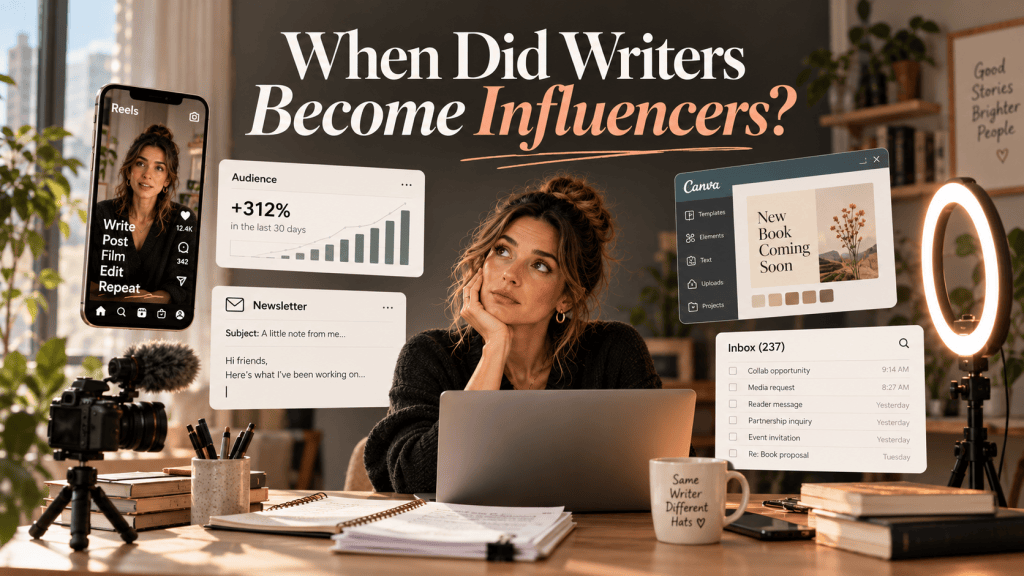
Somewhere between writing the book and selling the book, authors acquired a second career. Now we make Reels, build brands, study algorithms and package our lives as content. So, when exactly did being a writer stop being enough?
There was, apparently, a meeting I missed.
For modern writers, author marketing increasingly means learning Instagram, Reels, Bookstagram and personal branding alongside the actual business of writing books.
At some point between write the book and publish the book, writers acquired several additional job titles.
We became social-media managers, video editors, copywriters, photographers, newsletter strategists, personal brands, community managers, amateur advertising executives and occasionally comedians, because apparently even books now need to be funny on Instagram.
Some of us have also become remarkably skilled at pretending that we just happened to be sitting beside a beautifully arranged stack of our own books while drinking coffee in excellent natural light.
And, increasingly, we are expected to become influencers.
I say this as somebody who cannot even stand outside the phenomenon and point at it accusingly. Because I am thoroughly inside it!
I am an author. I am an editor. I work in publishing. I create content. I write captions. I make Reels. I think about hooks. I look at analytics. I have spent an unreasonable amount of time wondering why something I worked on for three hours received 100 views while something I filmed almost accidentally crossed a thousand.
So this is not going to be an essay about how social media is destroying civilisation.
I like social media.
I have discovered books through Instagram. I have discovered writers through Instagram. I have made professional connections there, found readers there, talked about books there and watched wonderfully strange little communities form around literature there.
Bookstagram, in particular, has created an enormous space in which books are not merely purchased and read; they are discussed, photographed, recommended, criticised, collected, annotated and loved publicly.
That is rather wonderful.
But I think we need to admit that something strange has happened alongside it. The publishing industry has gradually convinced writers that being good at writing is no longer enough.
And perhaps more importantly, it has convinced us that this is perfectly normal.
When did the author become the marketing department?
Let us get one thing out of the way first. The romantic idea that authors once simply wrote books while publishers handled absolutely everything else is largely fantasy.
Authors have always participated in publicity. They gave interviews. They attended readings. They signed books. They appeared at literary festivals. They toured. They wrote essays for newspapers. They cultivated relationships with reviewers, booksellers and journalists.
Writers have never been entirely excused from selling their work. But there is an important difference between participating in publicity and being expected to operate your own miniature media company.
Today, writers are frequently advised to start building an “author platform” before the book is even finished. Hell, I advise my own writers to do so.
Now, platform is an interesting word because it sounds reassuringly professional. And a genuine author platform can be valuable. Publishing commentator Jane Friedman defines platform essentially as your ability to sell books because of who you are or who you can reach, and importantly, she has repeatedly distinguished meaningful platform from merely screaming for attention online.
That platform might include your professional expertise, published work, speaking engagements, mailing list, community, existing readership or reputation.
All perfectly sensible.
But somewhere along the way, “build a platform” became culturally entangled with:
Post consistently.
Make Reels.
Show your face.
Show your writing desk.
Talk about your characters.
Explain your process.
Do a cover reveal.
Make a carousel.
Film an unboxing.
Use trending audio.
Tell us five things nobody knows about you.
Tell us three things your protagonist would order at Starbucks.
Be authentic.
But also strategic.
Be vulnerable.
But aesthetically.
Be spontaneous.
At approximately 7:30 p.m., preferably. Oh… And please remember to finish the novel.
There is something inherently ridiculous about telling a person engaged in one of the most solitary, concentration-intensive forms of creative work that the best thing they can do for their career is also become permanently visible.
Its description opens by acknowledging “all the pressure to build a social media following and conquer the algorithms” and promises authors ways to escape “algorithm-chasing burnout”.
That phrasing interests me. Because nobody needs rescuing from something that isn’t happening.
The Authors Guild has also previously studied how authors spend their time. In its report on the changing profession of authorship, 84 per cent of surveyed authors said they spent time marketing. Full-time traditionally published writers averaged around seven hours a week on marketing, while self-published writers averaged 12.4 hours — before counting many of the other production tasks indie authors perform.
Seven hours.
That is almost an additional working day every week. Twelve hours is roughly a day and a half. Imagine what writers could do with another twelve hours. They might even write.
And the particularly interesting twist is that all this social-media labour does not necessarily translate neatly into sales.
In the Authors Guild’s 2023 Author Income Survey, respondents typically rated social media and blogging among the least effective marketing channels, while email newsletters, ebook promotions and subscription programmes ranked more highly.
So we have arrived at an extraordinary little situation.
Authors feel enormous pressure to maintain social-media visibility. They spend significant time doing it. And the relationship between that activity and actual book sales is often maddeningly difficult to prove.
Welcome to modern authorship.
In India, this pressure has somewhere obvious to go: Instagram
For Indian writers, the conversation is slightly different from markets where TikTok dominates book discovery.
We have Instagram.
And Instagram in India is enormous.
Meta-commissioned IPSOS research released in June 2026 found that short-form video had become deeply embedded in everyday Indian digital behaviour, with 97 per cent of respondents saying they watched video on Meta’s platforms daily. Among Gen Z respondents, 89 per cent used Reels every day. Meta’s research also found strong creator-led discovery and purchasing influence across the platform.
Obviously, books are not shampoo.
Although judging by the current enthusiasm for sprayed edges, foiling, embossing and matching bopokmarks, we are getting dangerously close to packaging them like luxury skincare.
But books live inside the same attention economy as everything else. Readers scroll. Publishers scroll. Book reviewers scroll. Authors scroll. Potential buyers scroll. And naturally, publishing has moved towards the places where everybody’s attention already is.
Bookstagram did not create influencer marketing in publishing, but it became one of its most recognisable literary forms. Publishers Weekly was writing about publishers using Bookstagrammers and other online influencers for book promotion as far back as 2018, describing influencer campaigns as increasingly important to digital marketing.
By 2022, the same publication described Bookstagram outreach and PR mail as a standard publicity tactic, with publicists actively identifying literary influencers whose audiences suited particular books.
That is not inherently sinister. It is marketing. The uncomfortable part begins when we move from: Publishers use influencers to market authors’ books to: Authors themselves are expected to become the influencers.
Those are two very different propositions.
Because publishers love an audience that already exists
From a business perspective, none of this is mysterious. Publishing is risky. A publisher can examine comparable titles, market trends, genre performance, author history, pricing, distribution and pre-orders, but nobody genuinely knows which book readers will suddenly fall in love with.
An author who arrives with 50,000 engaged followers solves part of that problem. They already have attention. They already have distribution of a kind. They already possess a direct line to thousands of potential readers.
This is particularly significant in nonfiction, where “platform” has mattered for decades. Expertise, visibility and access to a relevant audience can reasonably affect whether a proposal makes commercial sense.
But social following has increasingly entered the wider publishing conversation too. Publishers Weekly has documented how author followings became factors in book deals and how publishers began searching platforms such as Instagram for people who arrived with built-in audiences.
Again: commercially understandable. And creatively rather alarming.
Because when a publishing decision is influenced by an author’s ability to attract attention, what exactly are we measuring? The quality of the manuscript? The marketability of its creator? Or the publisher’s reduced cost of finding readers?
These things can overlap but they are not the same thing.
Here is my first unpopular opinion
A large audience is evidence that somebody is good at attracting an audience. And that is all it proves. It does not necessarily prove that they are a good novelist. It does not prove that they understand narrative structure. It does not prove that they can develop a character across 90,000 words. It does not prove that they have anything particularly interesting to say once the camera is switched off.
Likewise, having 312 followers does not mean somebody cannot write a magnificent book.
And yet follower counts are seductive because they are measurable. Writing quality is irritatingly difficult to quantify. You can put 83.7K FOLLOWERS into a presentation. You cannot put: Writes sentences that rearrange something inside your chest and remain there for twenty years into a spreadsheet.
Publishing is a business, and businesses like numbers. Yet, literature remains inconveniently resistant to them.
Some brilliant writers would make terrible influencers
I suspect this statement should be obvious.
Some writers are shy. Some are deeply private. Some are socially awkward. Some dislike cameras. Some are terrible at small talk. Some have absolutely no desire to tell 14,000 strangers what they ate for breakfast, which notebook they use or what song their protagonist would listen to after a breakup.
Some would rather rewrite Chapter Nineteen twelve times than lip-sync to trending audio.
Thank God for that.
Imagine if every great writer in history had first needed to demonstrate adequate Instagram engagement. Kafka would probably have deleted his account after three days. Virginia Woolf would have written 2,000 devastating words about the psychological violence of engagement metrics. Proust would still be recording the first Reel.
The point is not that introversion equals genius. It obviously does not. The point is that the skill set required to produce good literature is largely unrelated to the skill set rewarded by social media.
Where as literature can reward difficulty. Ambiguity. Patience. Interior thought. Contradiction. Slowness. An idea that takes 300 pages to reveal what it is really about.
It would be extraordinarily strange if the future of literature became disproportionately shaped by the people who are naturally best at communicating in fifteen seconds.
Bookstagram has also changed what a “book” looks like online
I say the following as somebody who loves beautiful books: We have gone slightly mad.
A book can now arrive looking less like a book and more like evidence seized from an extremely tasteful cult. And much of it is genuinely lovely.
Publishing has always cared about packaging. Covers have always sold books. Beautiful editions existed centuries before anybody had an Instagram account.
But Bookstagram intensified the visual life of reading. A book is no longer merely something we read. It can also be something we display.
Photograph.
Collect.
Arrange.
Coordinate.
Unbox.
Use as background décor while discussing another book.
And here comes unpopular opinion number two: Bookstagram has occasionally made us care more about the idea of a book than the book itself.
There.
I said it.
We can know a book’s colour palette before its plot. We can recognise its sprayed edges before we know whether the protagonist has a convincing motivation. We can know its tropes before we know whether its prose is any good. The marketing can become extraordinarily sophisticated before the reader encounters sentence number one.
Which brings me to perhaps my favourite test: A good book should survive an ugly edition.
A good book should survive an ugly edition.
Take away the sprayed edges. Take away the character art. Take away the candle. Take away the playlist. Take away the Instagram campaign. Put it in a terrible beige cover printed on paper that feels vaguely hostile.
Would you still recommend it?
If yes, wonderful. That is the book. Everything else is packaging.
And now Instagram is beginning to travel backwards into the writing
This is the part that concerns me most.
Social media no longer begins after the creative work ends. Writers are learning marketing while they are still learning craft. They are thinking about positioning before the manuscript is even finished.
They know which tropes are currently popular. They know which aesthetic sells. They know which hooks perform. They know which types of scenes become quote cards.
Again, market awareness is not evil.
Professional writers should definitely understand readers. Commercial fiction has always responded to reader appetite. Genre itself is built partly on expectation. But there is an enormous difference between understanding your market and allowing the marketing mechanism to become the creative mechanism.
There is a difference between:
What does this story need?
and:
What will look good in a Reel?
There is a difference between:
Who is this character?
and:
Which trope is this character?
There is a difference between using “enemies to lovers” as useful shorthand for readers and constructing two people primarily because ENEMIES TO LOVERS fits beautifully across the top of a graphic.
Writers should know how their books can be described. I merely hope the description continues to come after the imagination.
Here is the truly controversial part
I think some writers are spending far too much time learning how to market books they have not yet learned how to write particularly well.
That sounds horrible. But I don’t mean it horribly. I mean it with considerable sympathy because the internet encourages it.
Look at what an aspiring writer encounters online:
How to build your author brand.
How to grow on Instagram.
How to create a mailing list.
How to make viral Reels.
How to optimise Amazon keywords.
How to organise a launch team.
How to create a reader magnet.
How to build anticipation.
How to get ARC reviewers.
How to run Meta ads.
How to design your feed.
How to sell without selling.
Meanwhile, somewhere underneath this astonishing commercial infrastructure, Chapter Four still isn’t working.
Sometimes I want to take writers gently by the shoulders and say: You do not need a content strategy yet. You need to finish the bloody book.
Marketing is a professional skill. Learn it.
Publishing knowledge is incredibly useful. Learn that too.
Understand metadata. Understand distribution. Understand positioning. Understand your readership.
But there is a sequence.
Visibility cannot rescue a book that isn’t ready. And social media occasionally reverses that hierarchy. It teaches people how to look like authors before they have given themselves enough time to become writers. That distinction matters to me enormously.
We only see the photogenic part of publishing
Instagram shows us the finished copy. The cover reveal. The ARC box. The preorder announcement. The signing. The beautiful writing desk. The launch party. The screenshot of the bestseller ranking. The lovely reader review.
What it rarely shows us is Thursday afternoon in Draft Six when the writer discovers that the protagonist’s motivation makes absolutely no sense.
Nobody films the structural collapse.
Nobody makes an aesthetic flat-lay of:
“My editor has informed me that Chapters 12–19 require substantial redevelopment.”
Where are the unboxing videos for editorial letters? Where is the trending audio for deleting 18,000 words? Where is the glamorous Reel in which somebody realises the subplot they’ve worked on for four months contributes absolutely nothing and must die immediately?
Those are the parts of publishing I know particularly well. And those are the parts that make the book.
The invisible work is still the work.
Social media shows us what being an author looks like. It rarely shows us what becoming a good writer costs.
And perhaps that is why writers feel behind before they have even begun
If you are writing your first novel today, you can open Instagram and immediately encounter somebody announcing their sixth.
Another author has sold film rights.
Someone has received a thousand pre-orders.
Someone’s publisher has sent them a cake.
Someone has fifty thousand followers.
Somebody else’s desk is inexplicably free of cables.
And you are sitting at home trying to work out why your protagonist has been standing in the kitchen for eleven pages.
The comparison is absurd. But emotionally, it works.
The visible markers of authorship are now so public that writers can begin performing success before they have built the craft, career or body of work underneath it.
And worse, they may feel they are failing if they don’t.
This is what concerns me most about the influencer model of authorship. It doesn’t merely demand more labour. It changes what writers think they are supposed to be.
But here is where I ruin my own argument
Authors should market their books.
Yes.
I said it.
After approximately two thousand words of complaining about the marketing of books.
I believe authors should understand the business they are entering.
If you want readers, you need some mechanism through which readers can discover you.
A website is useful. An email list is extremely useful. Social media can be tremendously useful. Bookstagram can introduce a book to precisely the people likely to love it. A Reel can reach somebody your publisher never could. A thoughtful online community can support an author’s career for years.
And crucially, platform does not have to mean influence in the shallowest sense.
One of the most useful contemporary arguments about author platform comes from editor and writing coach Allison K Williams, who proposes a “lived platform” built around publication, meaningful projects and personal connections rather than simply chasing follower numbers.
That is a very important point.
Social media can be a tool. It does not have to become the job. The problem is not authors having Instagram accounts. The problem is opportunity slowly becoming obligation.
Publishers have responsibilities here too
Authors are repeatedly told that publishing has changed.
Fair enough.
Then we should be equally willing to say what that change means.
If authors are increasingly expected to create videos, maintain social channels, build email lists, cultivate reviewers, pitch media, organise communities and drive direct sales, then some of the labour that once sat more squarely inside publishing and publicity systems has moved towards authors.
Publishing margins are real. Marketing budgets are finite. There are more books than any team could promote equally. But we should stop pretending the solution is costless.
The cost is frequently the writer’s time. And time is the raw material from which the next book is made.
Perhaps we need to remember what authors are actually for
Authors are not inexpensive outsourced marketing departments. They are not content pipelines. They are not collections of engagement statistics attached to manuscripts. They are not pre-built consumer communities waiting for acquisition.
They are the people creating the thing the entire industry exists to publish.
They should participate in their careers. They should care whether their books find readers. They should understand the marketplace. They should promote their work in ways that suit their personalities, readerships and ambitions.
But I would like publishing to retain room for the person who says: I am very good at writing books and remarkably average at Instagram.
Because that person may have written something extraordinary.
I would like there still to be room for writers who are private. Writers who are strange. Writers who dislike cameras. Writers who aren’t funny online. Writers who never develop a personal brand beyond “person who writes exceptionally good books”. Writers with 214 followers. Writers who post twice a month. Writers whose desks are ugly. Writers who don’t know what a content pillar is. Writers whose greatest marketable asset is still the manuscript. Especially them.
Because if publishing increasingly rewards the people who are best at attracting attention, eventually attention begins influencing what gets written, what gets acquired and perhaps even what we come to believe good writing looks like.
Attention is valuable.
Attention can sell books.
Attention can create careers.
But attention and talent are not synonyms.
And I hope publishing never becomes too distracted to remember the difference.
A writer’s greatest marketable asset should still be the manuscript.
Do writers now have too much responsibility for marketing their own books?
I would genuinely like to know where you stand.
If you’re an author: has social media helped your writing career, or has it become another job sitting on top of the one you actually wanted?
And if you’re a reader: does an author’s social-media presence ever influence whether you buy their book?